
Your project managers are meeting-minute factories.
Your project managers spend most of the week manufacturing artifacts about the work, not landing engagements. Here is the operating layer we built, and the boundary we hold.

Published June 17, 2026 · Updated August 1, 2026
With contributions from Abiodun Fagbuaro.
Walk through your delivery organization and look at what your project managers actually do with their week. You hired them to land engagements on time and on scope. They spend most of the week manufacturing paperwork about the work.
Run the check on your own delivery:
Status by hand. Your project manager is collating updates the night before they go to the client.
Minutes rewritten. They are fixing what the notetaker got 70% of the way right.
Two days on a kickoff space. They are building out Confluence when the statement of work already says what goes in it.
The 9am scramble. They are working out what is blocked before standup.
The RAID log chase. Nobody updates it between meetings.
What actually moves an engagement forward is the other half of the job: managing the relationship, solving problems, carrying people through change, coaching the team. That is the work that does not fit in the week. PMI's 2024 research puts a number on the gap. 61% of senior leaders say their teams need more of exactly that. Training budgets are pointed elsewhere: PMI found organizations spend 46% of training hours on technical skills and 25% on business acumen.
The paperwork is where the time goes. The relationship is where the value lives. Closing that gap is the workflow we rebuilt for ourselves.
The workflow we rebuilt
One of our senior program managers, Abiodun Fagbuaro, piloted the rebuilt version on a real two-week client engagement. Statement of work in, a structured Confluence space and Jira project out, in minutes. Transcripts in, draft minutes and an updated RAID log out. Jira status plus RAID status in, client-ready report out. Every single deliverable reviewed by the program manager before it goes to the client.
Two weeks. Four deliverables. Nine standups. Nothing dropped.
What that replaces is the time the program manager used to spend producing paperwork. What it frees up is the work most of us took this job to do.
How it actually works
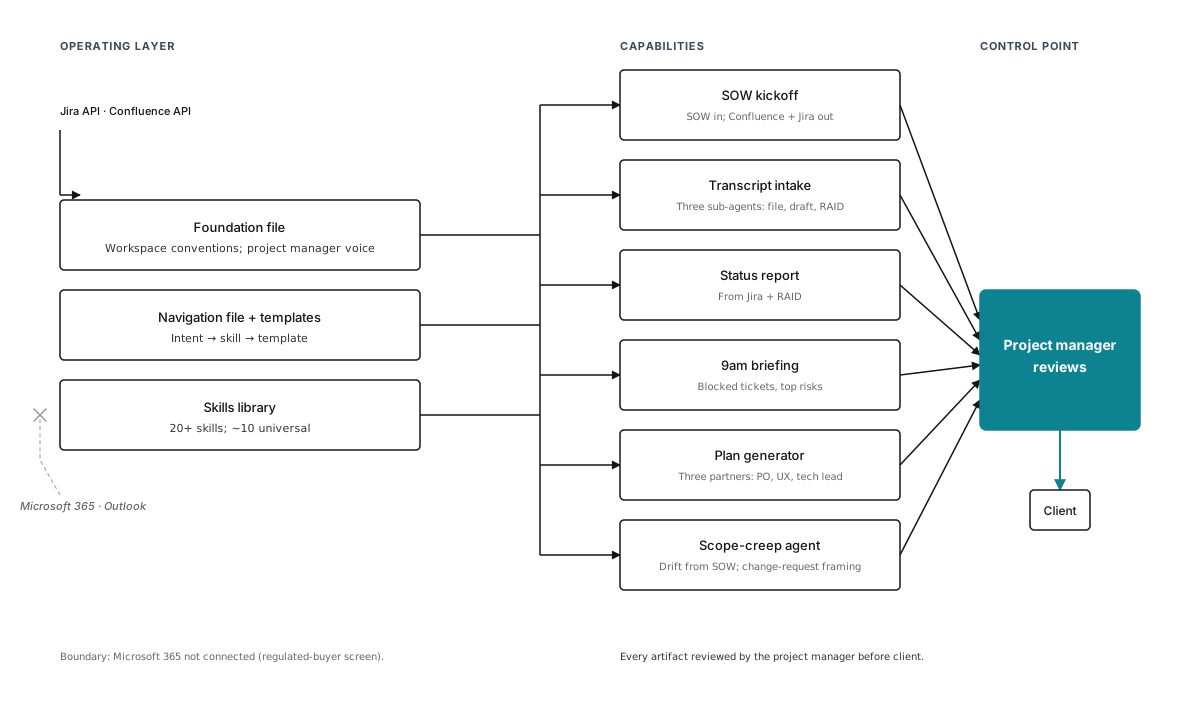
Underneath it sit three unglamorous things.
A written foundation. Our client conventions, naming rules, formatting standards, and each program manager's own writing habits, so a draft arrives sounding like that person rather than like a generic AI.
A directory. It maps an intent ("update the RAID log") to the right procedure and the right Architech template, so two program managers on two engagements produce consistent work.
A library of more than 20 written procedures. Around half universal across the team, the rest specific to an engagement. Each one is a folder holding the instructions and conventions for a single task.
It follows the pattern Anthropic published for giving AI reusable, written-down capabilities rather than one-off prompts.
On top of that scaffold, six things the program manager actually uses day to day:
Drop the statement of work in and the engagement scaffolding comes out. A structured Confluence space and Jira project in minutes, matching the documentation structure our practice areas agreed on two years ago.
Transcript in, three jobs done. One step files the transcript. One drafts the minutes. One updates the RAID log, closing risks that resolved, recording decisions that landed, and surfacing new items.
Status reports that assemble themselves from Jira and the RAID log. The program manager reviews and edits. They no longer write from a blank page.
A 9am briefing that scans the active projects, surfaces blocked tickets and the top risks, and lands before standup.
A project-plan generator with three built-in thinking partners (product owner, UX, tech lead) for clients who want a traditional plan alongside the agile work.
A scope-creep watch that reads conversations and deliverables against the statement of work and helps frame the change-request conversation when the drift is real.
Where we draw the boundary
Jira and Confluence are connected. Microsoft 365 and Outlook are deliberately not. A human reviews every deliverable before it goes to the client. Regulated buyers ask about exactly that combination.
The threats are real and current. Microsoft 365 Copilot had a vulnerability that required no click at all (EchoLeak) and let a single email pull out chat history. AI notetakers are facing class actions over recording consent and biometrics (In re Otter.AI and parallel Fireflies suits). On meeting minutes specifically, corporate-governance lawyer Douglas Raymond named the failure mode last August: AI "lacks the ability to interpret context, tone and nuance," and "the presence of the tool may naturally lead to decreased vigilance" (Directors & Boards, August 2025).
Human review is the control. Not a preference. The control.
"This doesn't replace project managers. It moves us up, to the work most of us in this role want to do: relationship management, problem-solving, change management, coaching the team." Abiodun Fagbuaro, Architech Senior Program Manager
The proof gap in AI services
AI firms do not generally publish a first-person account of rebuilding one of their own workflows, named, with the mechanism shown, the human-review discipline visible, and the boundaries stated. This is one. It is the third in a row from us, after the piece on our content workflow and the one-claim test. When operators evaluate AI firms now, "do you run this on your own delivery?" is becoming the first question rather than the last.
David put it this way about what Abi built:
"What Abi did with this operating system is what 10x looks like inside Architech now: a project manager who found his superpower and used it to free himself for the work that actually moves clients. That's the bar. It's what I expect, what our clients are starting to demand, and what makes us worth hiring over anyone else." David Suydam, CEO
What we would do differently
One program manager piloted this on one engagement. Getting it into the hands of the whole team is the current phase. The package is built: the written foundation, the procedure library, the directory, the templates. The harder part is fitting it to the shape each program manager's engagements actually take. That gap, between a pilot that worked once and a workflow the whole team runs, is where this work usually stalls.
The Microsoft 365 boundary stays. So does the result the pilot was measured on.
Why this matters when you hire an AI firm
This is what our delivery looks like when we run our own methods on it. The result is how we know it worked: four deliverables shipped, nine standups run, nothing dropped, on a two-week engagement. Paperwork absorbed. Relationship work freed. We connected the systems that help. We deliberately left out the ones that carry risk.
When you evaluate an AI firm next, ask two questions. Does the firm run this on its own delivery? And when the AI drafts the minutes, who reads them before they go to the client? Here is how we run it for you.
See where AI will pay off in your operations.
Pick one workflow that matters to you and answer a few focused questions. You get a workflow-specific read on where AI can move a real number for you. It also names what stands in the way and the right first step for your situation.
A clear read on the one workflow you choose, not a generic AI-readiness label or a roadmap you will never use.
Email required after the fifth question. Your results are built around the workflow you name.
What you receive
- A workflow-specific read on the one process you choose, not a generic AI-readiness label
- The risks that would block, slow, or add cost to change, and the minimum work to clear each one
- A view of what a short self-serve scan can and cannot see
- One recommended first step, reasoned from your own answers
- A three-line summary you can forward to a CFO or CEO in one paste
Prefer to go straight to scoping, or talk to an engineer?