
Every AI homepage says the same thing
AI-services homepages sell verbs because verbs commit to nothing. The test that filters them: name a workflow, a metric, an operator whose job changes.

Published April 28, 2026 · Updated August 1, 2026
If you run operations at a mid-market company, you are being pitched AI by firms whose homepages you can no longer tell apart. Maybe your team has not been cleared to use AI tools yet. Maybe you have eighteen months of pilots behind you that made a few tasks faster and changed nothing about how the business runs. The pitches arrive the same way regardless: open with a verb, promise something you cannot test, close with a meeting request.
Read the next ten in a row and you will see the shape.
Accenture's AI and data page reads, "In the last 30 years, no technology has promised to change everything across a business—until generative AI."
Deloitte's GenAI landing leads with, "The true power of GenAI comes from humans with big ideas."
EY's AI blueprints page: "Shift from bolt-on AI to built-in AI with scalable blueprints that unlock innovation, new models and enterprise-wide transformation."
Cognizant: "Empowering better, faster decision-making with data and AI services."
All four quotes are verbatim from those firms' own pages as of 1 August 2026. These are serious firms that deliver real work. Pasted next to each other, not one of them commits to a claim a competitor would disagree with, and not one names the workflow that gets rebuilt, the number that moves, or the person whose job changes.
A fifth firm we quoted when this test first ran in the spring has since rewritten its page around named clients and moved numbers. Good. That is the test working.
The category sells verbs. Verbs commit to nothing.
That is fine for tone. It is not enough to choose a vendor. An operator weighing five AI vendors does not have time for five conversations. They have time for a filter. A homepage that does not say what changes for them gets filed under "another one of these."
Something is missing, and their own numbers show it
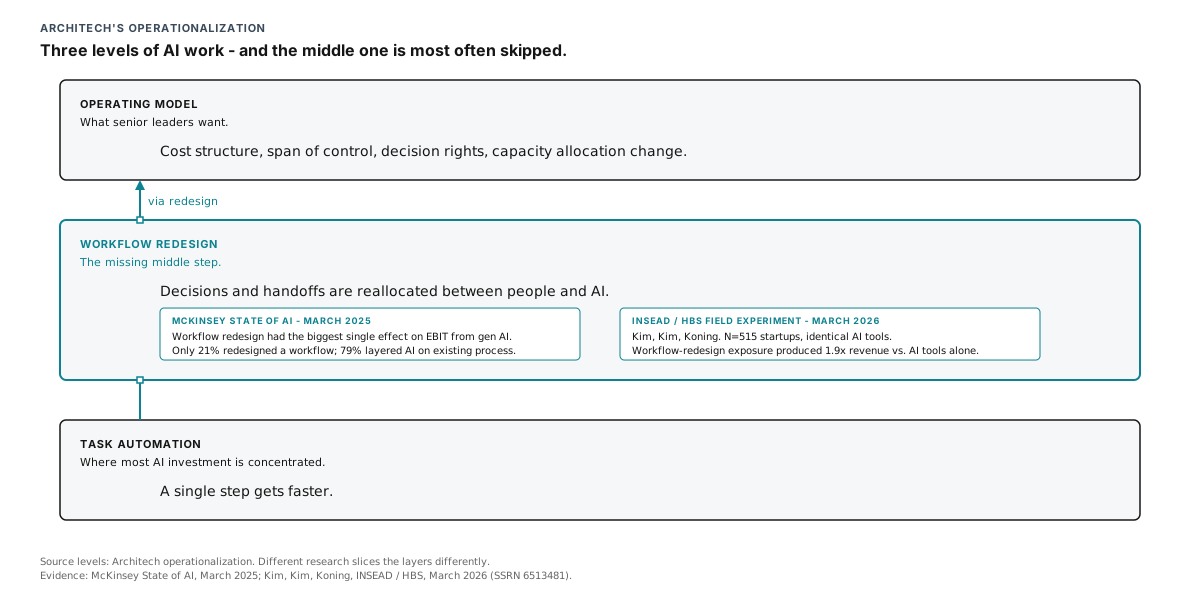
The category's own research is the strongest evidence that something is missing. McKinsey's March 2025 State of AI tested organizational attributes against profit impact from generative AI.
Redesigning workflows had the single biggest effect on profit impact from generative AI.
Only 21% of companies using generative AI have fundamentally redesigned even some of their workflows. The other 79% have not. The layer between "we let people use ChatGPT" and "we changed how the company runs" is where the work is, and most AI investment skips it or defers it.
A controlled field experiment from INSEAD and Harvard Business School, published in 2026 by Hyunjin Kim, Dahyeon Kim, and Rembrand Koning, found the same thing under controls. Every firm in the study had identical access to the same AI tools. One group also received case studies showing how AI-native firms reorganize the work itself around AI. That group generated 1.9x the revenue of the control group. The variable was not AI. It was reorganizing the work (SSRN 6513481).
Those two findings are the spine of the claim this firm is built on:
Redesigning the workflow is the missing step between faster tasks and a changed cost structure. Most AI work skips it or defers it, which is why most AI spending shows up in task time and never in the P&L.
That is our framing, not an industry standard. We name three layers:
Tasks. A single step gets faster.
Workflows. Decisions and handoffs get reallocated between people and AI.
The operating model. Cost structure, span of control, decision rights, and where you put your capacity all shift.
The middle layer does most of the economic work. Most AI vendors are pitching the bottom one.
What a testable claim is, and why it filters
A testable claim has two properties.
A reasonable competitor could disagree with it. "We partner with you on your AI journey" is not a claim. "Redesigning the workflow beats automating tasks if you want the profit line to move" is.
You could check it inside ninety days, by asking the firm to name the workflow they would rebuild and the number they would commit to moving.
Run that test on the homepages above and most describe the firm's posture, not the work that follows. We ran it on our own old homepage. It would not have passed. We had verbs.
Why the missing step gets skipped, even by serious firms
The step does not get skipped because firms are unserious. It gets skipped because tasks are easier to scope, demo, and invoice in ninety days. Redesigning a workflow needs two things AI firms commonly under-invest in.
At the front: senior advice that helps leadership decide which workflow to rebuild, from someone willing to recommend stopping.
At the back: the work of getting the rebuilt workflow into daily habit, not just switched on.
That second gap is measurable. WalkMe's November 2025 survey found 28% of employees know how to use their company's AI. Deployed AI is not used AI.
MIT's 2025 State of AI in Business report, covered by Fortune, said it plainer:
95% of enterprise AI pilots deliver no measurable ROI.
The 5% that succeed "pick one pain point, execute well, and partner smartly with companies who use their tools." Generic AI dropped into a workflow nobody has rebuilt produces faster tasks and silence at the P&L.
Decide, rebuild, embed
Redesigning the workflow is the missing step, but it is not the only one. It is the middle of three, and a firm's claim only holds if it can carry all three.
Up front, AI Jumpstart is three weeks of executive-led work that decides where AI will deliver measurable impact, and whether to act at all. We watch the work as it actually runs in three areas of the business, score the candidate workflows, and end in a go/no-go: rebuild a specific workflow, or stop.
In the middle, Workflow Transformation is the plan and then the build. A Transformation Blueprint takes the workflow apart, reallocates decisions between people and AI, and commits to the number the rebuild has to move; if you do not accept the Blueprint's outcomes, you do not pay for it. The Build then puts the rebuilt workflow into your live operation. We never build without the blueprint.
At the back, Workflow Activation is what the category routinely skips: getting the rebuilt workflow into habitual use and tracking the number it was supposed to move.
We are willing to claim that position because we used it on ourselves first. We rebuilt how we produce content and then how our program managers run engagements, publishing the mechanism and the failure in both cases, before recommending the same discipline on workflows our clients own.
"But tasks are the safer on-ramp"
The cleanest counter comes from the task-automation side. Tasks first, the argument goes, is the cheaper, lower-risk way in: the platform vendors tell operators to start with high-value tasks that are time-consuming, error-prone, or critical to outcomes, and let the automations compound into AI-integrated processes over time. Plenty of firms sell that on-ramp, and it is real work. It is not the same product as a rebuilt workflow, and it should not be priced or judged as if it were.
The data does not support the compounding. Tasks alone do not add up to a change in how the company runs. INSEAD shows it under controls, McKinsey shows it at scale, and the adoption gap shows why. If what you want is an actual change in cost structure, span of control, or who decides what, the firm you hire has to do the middle layer. Most of the category is not selling it.
A test you can run this week
Open the homepages of the AI firms on your shortlist, including ours. For each one, write down a single sentence describing the claim, in the firm's own words.
If it could be pasted onto any other firm's site without editing, it is not a claim. If it does not name a workflow, a number, or a person whose job changes, it is not a claim. If it cannot be checked inside ninety days, it is not a claim.
Most will not pass. That is the diagnostic. The firms that do pass will not all be Architech, and they should not be. Apply the test to all of us, including the one writing this.
We built architech.ca around one claim, the one in this piece. Test us on it. The category has stopped making claims you can check. An operator with a vendor budget has every right to make that the first filter.
See where AI will pay off in your operations.
Pick one workflow that matters to you and answer a few focused questions. You get a workflow-specific read on where AI can move a real number for you. It also names what stands in the way and the right first step for your situation.
A clear read on the one workflow you choose, not a generic AI-readiness label or a roadmap you will never use.
Email required after the fifth question. Your results are built around the workflow you name.
What you receive
- A workflow-specific read on the one process you choose, not a generic AI-readiness label
- The risks that would block, slow, or add cost to change, and the minimum work to clear each one
- A view of what a short self-serve scan can and cannot see
- One recommended first step, reasoned from your own answers
- A three-line summary you can forward to a CFO or CEO in one paste
Prefer to go straight to scoping, or talk to an engineer?