
The Fix Wasn't an Agent. It was an Org Chart.
In February 2025 we did exactly what we tell clients not to do. We automated our own content workflow with nobody left in it who could say no, and we shipped slop. The fix was not a better AI agent. It was a reporting line. The editor has a veto, and the person responsible for shipping cannot override it.

Published April 22, 2026 · Updated August 1, 2026
What made our content workflow stop shipping slop was not any of the AI agents we introduced. It was the editor reporting to me directly, with a veto the content director cannot override. One structural decision. No agent involved.
We learned what happens without it the hard way. In February 2025, architech.ca published six articles on customer experience inside three weeks. Five of the six were near-duplicate search-bait templates under a generic "Architech" byline, two of them near-identical text under different titles. All five shared the same telecom scenario, the same recycled Gartner statistics, and the same "Schedule a 30-minute consultation" close. All five were aimed at CIOs and CTOs, not at the operator who actually buys our work. None contained a single piece of proof that came from us. We took them down when we relaunched the site in April 2026.
An AI-first services firm, writing publicly about AI, using AI as its primary author, produced the exact slop pattern the industry complains about. There was nothing between the draft and the publish button. That cluster is why this piece exists.
If you run operations at a mid-market company, you have been told by AI firms, including ours until recently, to be careful about where AI touches your workflows. MIT's 2025 State of AI in Business report, covered by Fortune, found that 95% of enterprise AI pilots deliver no measurable ROI. The failure mode is well documented. The advice is consistent. The firms selling the advice are rarely asked whether they have ever rebuilt one of their own workflows the same way.
We had not. The February 2025 cluster is the evidence.
AI firms rarely publish their own redesigns
AI firms usually keep their own workflow redesigns private. The firm redesigns workflows for clients. It talks about the client's outcome. It does not publicly document a workflow it rebuilt on itself, because the internal operation is not positioned as proof. Proof is the case study.
That habit has a cost. When 95% of enterprise pilots return nothing measurable, and the ones that work are, per MIT's Aditya Challapally, the ones who "pick one pain point, execute well, and partner smartly with companies who use their tools," you have a reasonable question to ask us. Do you use your own tools? Have you run the discipline you are selling me on yourself? On what?
In February 2025 we could not answer in good faith.
What we rebuilt: an editor the director cannot override
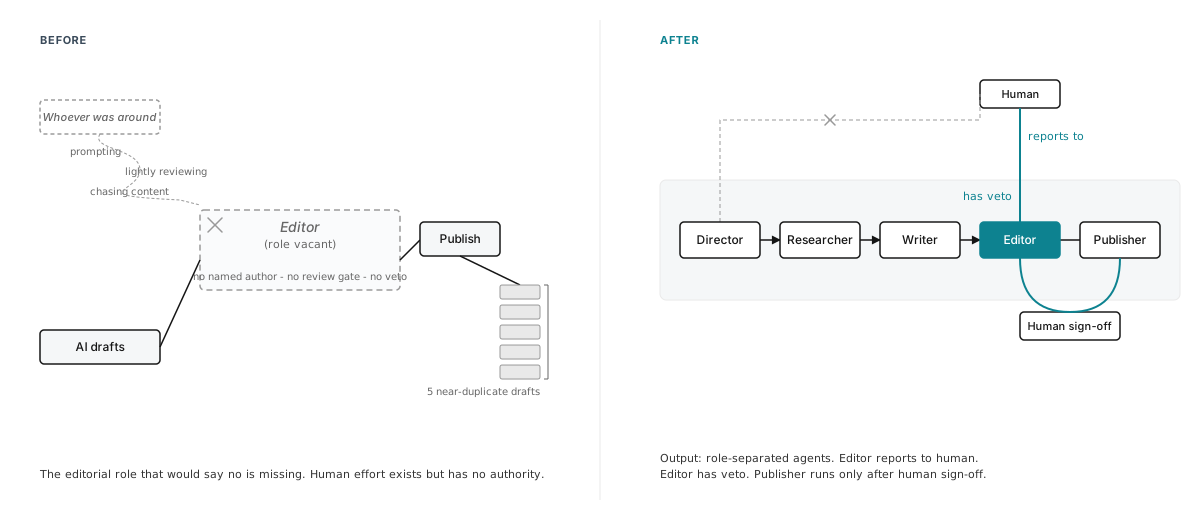
What let the slop ship. In February 2025 there was no editor in the content function at all. No named editor, no named author, no review step. AI-written drafts went to publish without anyone in the chain who could say no. The editorial role had been eliminated, and the marketing team that sustained the 2022 writing cadence no longer existed. It is a plain and primitive failure. Not a power-dynamic story. The thing that stops slop was simply missing.
Why putting the role back is not enough. Restore the editor and a second problem shows up as soon as the work runs at volume. Where AI is producing on a cadence, pressure to ship will beat editorial judgment unless the structure prevents it. When a director accountable for shipping and an editor accountable for quality both report to the same person, the tie resolves against quality most of the time. The predictable failure is not "editor absent." It is "editor overruled."
The design decision. We rebuilt the workflow as a set of AI agents with separate jobs, each one narrow and each one handing off to the next:
Director. Sequences the work and picks what gets produced next.
Researcher. Grounds every claim in a source.
Writer. Drafts.
Editor. Reviews against a written standard and can refuse.
Publisher. Runs only after a human signs off.
The editor reports to me directly, not to the content director who is responsible for shipping. The editor has a veto. The director cannot override it. Only I can.
Five design decisions sit behind that. Four of them matter to us and barely matter to you:
Social posts come off the source material, not off the blog draft. Nothing degrades down a chain of handoffs like a game of telephone.
Humans pick the topics. Not agents.
The whole thing runs where we build software, not in a separate workflow tool, which keeps the agents next to the work and its history.
The voice and positioning files the agents write against are live, kept in sync with our internal standards rather than copied once and left to rot.
The fifth decision is the one that actually mattered. The reporting line is the forward-looking fix, not a patch on the 2025 failure. February 2025 is what happens when the editorial role is gone. The reporting line is what keeps the role intact once it is back and the work is running at volume. The agents are not the claim. The reporting line is.
Early results.
The February 2025 cohort against the 2022 cohort. In calendar 2022, architech.ca published 14 posts written by named humans from delivery and leadership, including our COO and CTO, at roughly 1.2 posts a month. That cadence was sustained by a marketing function that no longer existed by early 2025. An audit of the 163-post Architech archive from 2016 to 2025 found four posts that clear our current bar for republishing. The best cohort is 2022. The worst is the February 2025 cluster. The variable that changed between them was not AI. It was whether an editor existed at all.
How people who run AI-assisted writing well describe the work. The accounts that exist agree on the shape: a person reads the output at the same five points. Someone reads the first draft. Someone checks the facts. Someone opens every citation, because AI invents citations that do not exist. Someone edits the draft into the company's own voice. And a named human decides whether it ships. Those five checks are not decoration on top of the AI. They are the workflow. Drop any one of them and the output slides back toward the February 2025 cluster.
The discipline of firms that are good at running their own tools. Use the thing. Let the use reveal the failure modes. Let the failure modes force the design.
Anthropic's own teams run Claude Code daily well beyond engineering: security, legal, and accounting too, not just the teams you would expect. Cursor's Aman Sanger frames using your own product as how the team stays "honest to ourselves of whether we find it useful" before shipping it to anyone else. 37signals' David Heinemeier Hansson calls it a floor you cannot fall through: "There's a baseline of quality you derive from something that the people who are working on it also have to use. It can't just be broken." None of those three is an AI services firm. All three do it anyway.
Content is not claims processing. The failure still generalizes.
The strongest argument against publishing this piece is that a content workflow is not a claims-processing workflow. Slop articles on a corporate blog are low stakes next to a $50M-revenue operator deciding whether to let AI touch customer onboarding. The structural differences are real. Our publishing cadence is internal. We have no external service-level agreement. We are a small team with one senior person holding a lot in their head. None of that generalizes to a 2,000-person operations function.
I think the counter is right on structure and wrong on the failure mode. The February 2025 cluster is the same failure MIT describes in enterprise pilots: templated output, no first-person proof, nobody with the standing to stop it between the draft and the publish. The domain differs. The mechanism does not. If an AI firm cannot detect and stop this pattern in its own content operation, you have a reason to ask whether it can detect and stop it in yours.
A second counter is worth naming, and it is our own: what we learned about the editor's veto is a specific lesson from one workflow, not a template. What transfers is the question, not the answer. Which step in your AI-assisted workflow, if you removed the person who could say no, would let the thing ship anyway?
The question to take to your own AI vendors
If you are evaluating AI firms right now, the signal worth looking for is not the language on the services page. It is whether the firm can describe a workflow of its own, named and specific, with decisions you can read, that it has rebuilt with AI under the same discipline it is proposing to apply to yours. If it cannot, the advice you are being sold has never been tried under the conditions it is telling you to accept.
Ours had not been, until this. Since then we have published one more: how our program managers run engagements, with the same mechanism detail and the same boundaries named.
If a firm's answer to that question is "we have not done it on ourselves yet," that is not a disqualifier. It is honest. "We have always done this," with no named workflow behind it, is the answer to watch out for.
One question to take to your own team this week: who has the authority to stop a ship date because the output is wrong, and does that person report to somebody being measured on the ship date? If the answer to the second half is yes, the veto is not structural. It is a favour the person with the deadline is choosing to grant, and favours get withdrawn under pressure.
See where AI will pay off in your operations.
Pick one workflow that matters to you and answer a few focused questions. You get a workflow-specific read on where AI can move a real number for you. It also names what stands in the way and the right first step for your situation.
A clear read on the one workflow you choose, not a generic AI-readiness label or a roadmap you will never use.
Email required after the fifth question. Your results are built around the workflow you name.
What you receive
- A workflow-specific read on the one process you choose, not a generic AI-readiness label
- The risks that would block, slow, or add cost to change, and the minimum work to clear each one
- A view of what a short self-serve scan can and cannot see
- One recommended first step, reasoned from your own answers
- A three-line summary you can forward to a CFO or CEO in one paste
Prefer to go straight to scoping, or talk to an engineer?